Contents
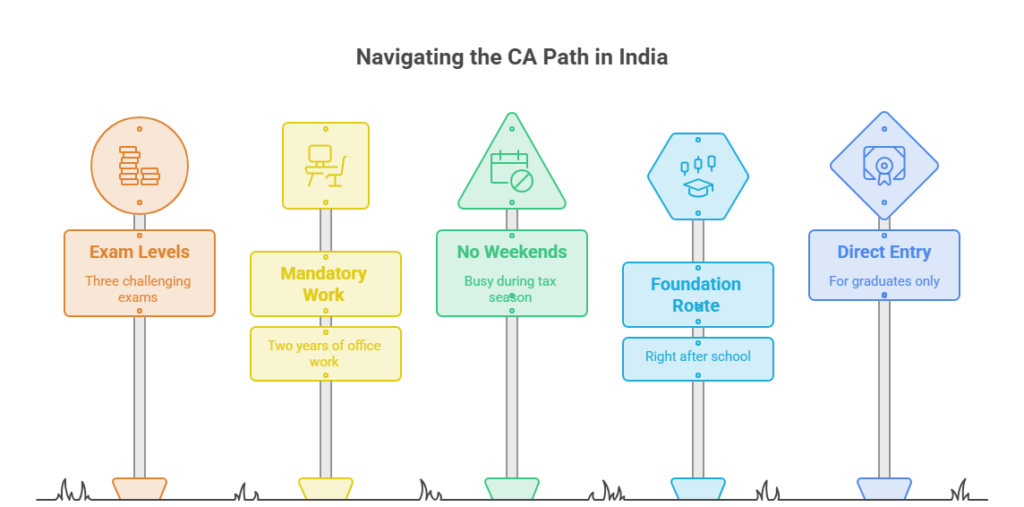
ToggleFiguring out how to become CA in India takes patience. The Institute of Chartered Accountants of India (ICAI) recently updated the training structure. You have three exam levels and two years of mandatory office work ahead of you. Expect no weekends off during tax season.
Most students enter the Chartered Accountant course in India right out of school. You sit for your 12th board exams and immediately register with the Board of Studies. This is the Foundation route. You can apply regardless of your stream. Commerce students usually clear the basic accounting paper easily. Science students often struggle with journal entries initially but catch up during the mandatory four-month study period.
Then you have the Direct Entry route. This path is strictly for graduates. You bypass the Foundation exams entirely. You need a 55% aggregate score if you hold a commerce degree. Non-commerce graduates need a 60% score. Students who passed the intermediate levels of the Company Secretary (CS) or Cost Accountant (CMA) programs also qualify for direct entry.
The Exam Progression
Starting your CA course after 12th means facing the Foundation exams first.
You prepare for four papers. Accounting, business law, quantitative aptitude, and business economics. You need 40 marks in each subject and a total of 200 out of 400 to pass. People fail the law paper because they write general, common-sense answers instead of citing specific provisions of the Indian Contract Act. You have to write the exact legal provisions.
Clear Foundation and you hit the Intermediate level.
The syllabus splits into two groups. Group 1 has advanced accounting, corporate laws, and taxation. Group 2 handles cost and management accounting, auditing, and financial management. You can attempt both groups together or one at a time. I recommend clearing both together. It saves six months of your life.
Many students fail taxation at this stage. They try to memorize sections. You cannot memorize your way through tax. You have to understand how income from a house property interacts with business losses. Examiners test your ability to apply the law to a specific client scenario.
Articleship Training
Before stepping into a firm, you complete four weeks of Information Technology and Soft Skills training (ICITSS).
Then the real work starts. Articleship is a two-year mandatory training period under a practicing CA. You will file GST returns, conduct bank audits, and prepare balance sheets for actual companies. You sit in client offices going through physical purchase bills. You will find discrepancies between what the client claims and what the bank statement shows. You learn to handle difficult clients who refuse to pay their advance tax on time.
You get a monthly stipend. ICAI sets the minimum limits based on the city population.
Under the new scheme, you cannot write your Final exams during this period. You focus entirely on your office work.
This training separates you from regular commerce graduates. You learn how tax laws apply to a client who lost their purchase invoices or a manufacturing company trying to claim specific machinery depreciation. The Chartered Accountant course in India heavily prioritizes this practical exposure. The two years teach you how businesses actually operate behind the scenes. You see exactly why companies fail and why they succeed.
The Final Stage
Six months before your articleship ends, you complete advanced IT training. You also clear self-paced online modules on corporate law and strategic cost management. Pass these, and you sit for CA Final.
The Final exams test advanced application. Financial reporting requires you to consolidate balance sheets of holding and subsidiary companies involving complex foreign operations. Advanced Auditing tests your knowledge of professional ethics. If a CA does something wrong, what penalty applies? You have to quote the exact clause from the Chartered Accountants Act. Clear this stage, and you secure the ICAI membership.
When people search for how to become CA in India, they rarely look at the syllabus volume.
You need a strict study plan. The volume of information is massive. Preparing for the CA course after 12th requires at least ten hours of study every day near the exams. You have to write mock tests physically. The ICAI examiners deduct marks if your working notes are messy. They check your step-by-step calculations, not just the final answer. Simply reading the study material creates a false sense of confidence. You only realize you cannot recall the exact auditing standards when you sit in the exam hall.
Your decision to join the Chartered Accountant course in India changes your daily routine for the next five years. You miss family functions. You skip weekend trips. Your friends in regular colleges will have free time while you attend tax classes at 6 AM. You have to accept this reality before you register.
Career Options And Salary
Qualified CAs do not just file taxes. Companies need professionals who understand compliance and financial reporting.
- Statutory audit for multinational corporations
- Internal risk assessment and fraud detection
- Chief Financial Officer roles managing budgets and forecasting
- Independent practice handling private clients
Starting salaries sit between ₹8 to ₹12 lakhs a year. Rank holders get more during campus placements. Firms pay for your ability to legally sign official audit reports.
Making The Right Preparation Choices
Watch this insight from Suresh Agarwal on what makes Straight Shot CA different:
You need proper coaching. Self-study works for school exams. Intermediate and Final taxation laws require someone who practices the law to explain it.
When evaluating your options, look at the faculty. The best CA institute in india will have teachers who share actual office experiences. A teacher just reading sections from the Income Tax Act wastes your time. You want regular mock exams evaluated strictly according to ICAI standards. You deserve the best CA institute in india to help you clear these hurdles.
Many students struggle with the CA course after 12th because they underestimate the syllabus volume and rely on summary notes. Summary notes do not work for ICAI exams. You have to read the core study material.
At Straight Shot CA, our faculty simplifies the heavy ICAI material. We break down the complicated tax and audit terminology into plain English. Our students practice with real-world financial scenarios instead of abstract theories. We provide mock tests that mirror the strict evaluation standards of the actual exams. We built Straight Shot CA to be the best CA institute in india by focusing on concept application rather than rote memorization. Our goal is to get you through the syllabus efficiently. Our mentors guide you through every stage, ensuring you know exactly what the examiner wants to see on your answer sheet.